Nov 1, 2026Wholesale & Customization
Woven Wall Art vs Metal Wall Decor: Which Fits Your Wholesale Range?
Comparing cotton-rope wall art and metal wall decor for resale? See which products fit retail and hospitality buyers before requesting a wholesale quote.
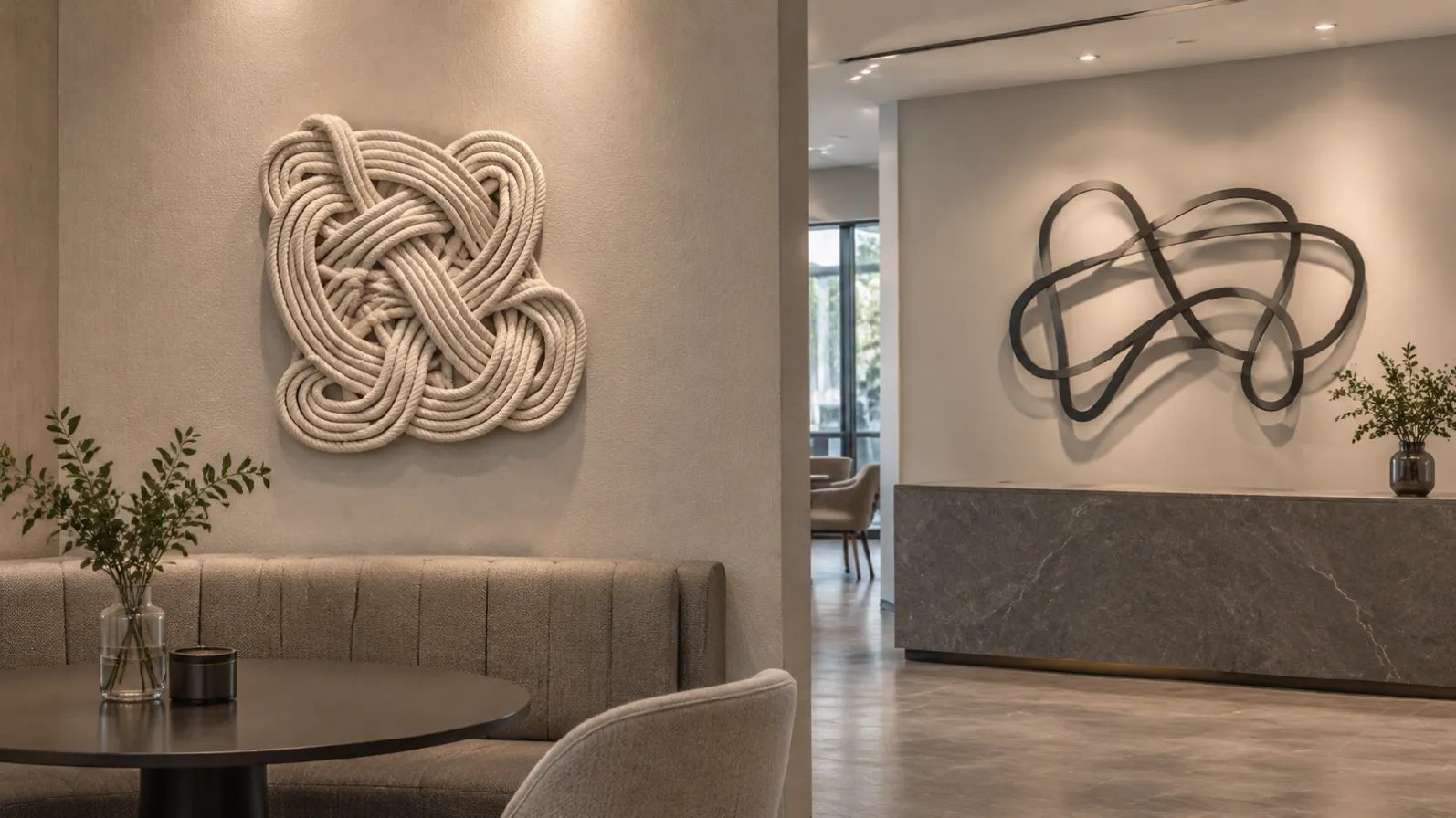
A retail brand can sell a cotton-rope wall sculpture as a specific decorative design. A hospitality distributor may offer a metal wall feature to several restaurant and hotel clients. Both are wholesale wall décor opportunities, but the customers are not necessarily buying the same visual result—or the same kind of product.
A hotel owner selecting one reception feature asks whether the finished piece suits that space. A wholesale importer selecting a range asks another question: can the item be described accurately, shown clearly to different trade customers and offered again if the market responds? Neither question is answered by simply declaring woven art more natural or metal art more durable.
For MUENHUIDECOR, the comparison is grounded in two actual product directions: cotton-rope macramé wall art and metal or metal-and-wood wall objects. The purpose is to choose between saleable designs, not to rank all textiles against all metals.
First Decide Who Will Buy the Finished Wall Piece
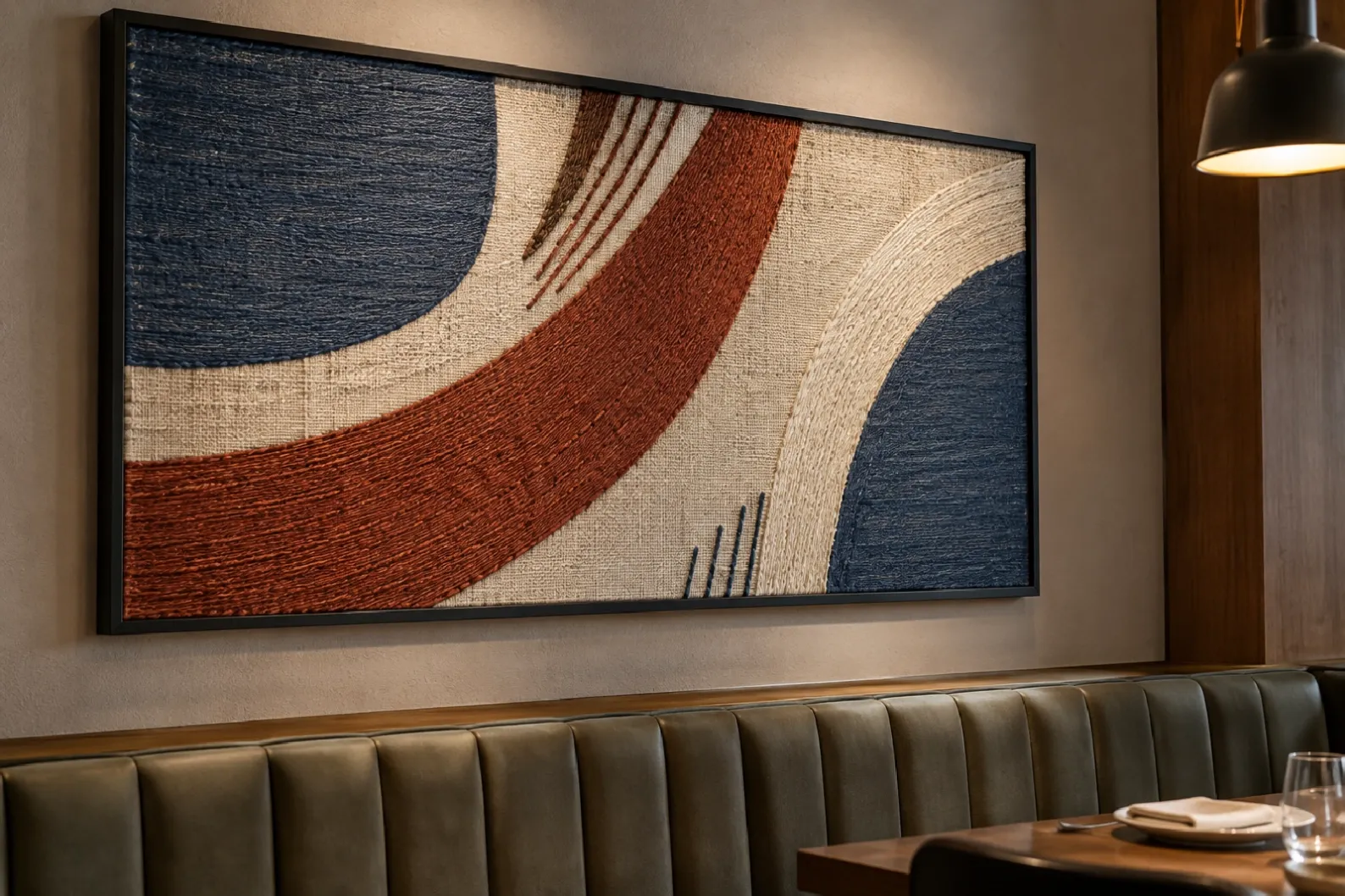
A lifestyle retailer might be looking for a distinctive fiber-art product to present with natural-looking home accessories. Its customer is buying the overall form, the visible cord arrangement and the hanging as one recognizable product. Calling it only “beige woven wall art” hides what makes that particular item different.
An importer supplying design stores may instead want a metal composition whose outline is immediately understandable in a catalogue. Here the object is recognized by the shapes and openings in its design, rather than by a broad style label such as “modern metal décor.” A mixed iron-and-wood piece would be a separate product identity, not a substitute for an all-metal one.
A hospitality-focused distributor works across another set of buyers. One restaurant may need a feature behind a reception desk, while a boutique hotel may need a quieter wall accent near a seating area. The material category suggests a design direction; it does not prove suitability for either site.
What “Woven Wall Art” Means When the Product Is Macramé
In retail searches, woven wall art is sometimes used broadly for fiber wall decoration. Technically, however, woven fabric and knotted macramé are not identical methods. Macramé is principally formed by knots in cord; it should not automatically be marketed as loom-woven textile or embroidery.
MUENHUIDECOR's circular cotton-rope macramé wall sculpture is one example of a defined fiber-art form. Its public listing describes cotton rope, a circular composition and wall-hanging use. The design's shape and visible rope arrangement are a better basis for a retail description than an unsupported claim about how every section was woven.
The horizontal gradient cotton-rope macramé hanging is visibly a different product direction, with a broader format and tassel-led composition. A distributor should not describe it as merely another size of the circular sculpture. The particular finished model, not the shared material name, defines what the buyer is offering.
For hospitality interiors, cord and layered forms can contribute a textured visual accent. That statement does not establish sound absorption, fire performance, machine washability or suitability for damp locations. Such claims require evidence for the individual product.
Metal Wall Decor Is a Design Direction, Not One Uniform Material
A metal wall object may be read as a solid decorative shape, an open botanical form or a more architectural outline against the wall. That appearance can be relevant to a retailer wanting a distinct graphic product or a hotel operator looking for a recognizable feature. It does not make the piece suitable for every building or installation.
The MUENHUIDECOR abstract cast-iron wall object uses a botanical-style open composition. Its listed material is cast iron. The metal-and-wood abstract wall décor, however, combines iron and wood. These are different commercial products, even if a buyer initially finds both under “metal wall décor.”
A metal-looking finish does not establish solid brass, stainless steel or any particular corrosion protection. A product name alone cannot establish weight, fixing requirements or durability. This article therefore compares what the two product directions communicate to buyers—not technical metalwork, installation depth or surface-finishing methods.
Which Direction Fits Each Wholesale Sales Channel?
Commercial buying situation | Cotton-rope macramé or other fiber art | Metal or metal-and-wood wall décor |
|---|---|---|
Retail brand serving customers who actively look for textile-led accents | A defined knotted design can be sold through its visible fibers, shape and hanging format | A different offer; useful only if its graphic form suits that brand's actual assortment |
Importer serving contemporary decorative-product stores | May suit accounts that stock fiber sculpture as a distinct category | May suit accounts looking for a clearly outlined wall object or open-form feature |
Distributor supplying boutique hospitality buyers repeatedly | Consider when the actual product suits the client's intended wall and care requirements | Consider when the actual design suits the client's desired silhouette and wall context |
Hotel or restaurant buying for one location | Review the selected artwork and site conditions; do not assume general textile suitability | Review the selected artwork and site conditions; do not assume general metal suitability |
This is a commercial positioning comparison, not evidence that one material will outsell another. Sales performance, customer response and repeat-order demand cannot be inferred from catalogue photographs.
The First Sale Should Identify a Real Product, Not a Material Trend
Suppose a small retail brand is considering one rope wall sculpture and one metal wall object. The decision is not necessarily to buy both, nor to select whichever is cheaper. One may serve an existing customer segment; the other may be a new offer requiring a different sales presentation. Without evidence of demand, it would be misleading to call either a guaranteed best-seller.
For a continuing wholesale line, preserve the selected product reference and the defining design customers are actually purchasing. A later request for “the same woven wall décor” is ambiguous if the supplier has several cord constructions and forms. Likewise, “the same metal wall art” could refer to a cast-iron botanical object or an iron-and-wood composition.
This point concerns product identity at initial selection. It is not another guide to reorder scheduling, batch control or collection management. For those broader decisions, see MUENHUIDECOR's existing guide on choosing wholesale artwork collections for repeat orders.
Hospitality Suitability Cannot Be Inferred From the Material Alone
It is reasonable for a hospitality buyer to compare a textured cord artwork with an open metal composition. But location matters. A wall behind seating in a lounge, a busy corridor and a restaurant entry do not necessarily have the same conditions or requirements.
For a cotton-rope item, product-specific care information and any special property standards should be addressed before offering it for a defined location. For a metal or mixed-material wall object, the actual product dimensions and available mounting information matter. Neither “natural cotton” nor “cast iron” is a certification or a substitute for a site assessment.
Do not assume that one category is easier to clean, has superior fire performance, weighs less or will last longer. If the end customer has requirements for fire behavior, cleaning, wall substrates or approvals, those should be reviewed using the selected product's available documentation and the property team's site-specific assessment. A supplier catalogue image is not evidence of approval.
What Makes This a Wholesale Enquiry Rather Than Free Design Advice?
A distributor or retailer approaching a supplier with a real buying requirement is usually able to identify at least a product direction, intended customer, estimated commercial quantity and destination. The enquiry need not contain a complete specification, but it should be about an actual purchase rather than an open-ended request to design a hotel interior without a product or budget scope.
For example, “we are an interior retailer considering the circular cotton-rope wall sculpture for our spring assortment, approximately 40 pieces in one size for distribution in our market” describes a commercial discussion. The quantity here is only an illustration, not MUENHUIDECOR's MOQ. A hospitality supplier could instead identify a selected metal reference and a planned number of locations, then ask which product information is available for the intended application.
Buyers evaluating adaptations can refer to our separate custom and semi-custom décor supply overview. Any sizes, finishes, samples, order minimums or production timing remain subject to a product-specific review.
Choose a Specific Wall-Art Reference and Discuss Wholesale Supply
MUENHUIDECOR supplies decorative lighting, artwork and selected FF&E décor for international wholesale and hospitality buyers. Artwork can be discussed as a standalone category for retailers, importers, distributors and companies serving commercial interiors.
Browse the artwork collection for fiber-art references and the wall objects collection for metal and mixed-material wall décor. Catalogue descriptions show product directions, not guaranteed availability in every specification or volume.
For a focused conversation, share your company or brand, the selected product link or reference image, approximate size and quantity per design, destination country, and whether the item is intended for retail resale, continuing hospitality supply or one named project. If repeat purchases are a possibility, identify the intended sales channel and the design you would want to retain. Include a buying range or requested arrival date if known.
Send your wholesale wall-art enquiry so we can review a specific product and quotation scope rather than a generic material comparison.