Oct 29, 2026Wholesale & Customization
Wholesale Shelf Decor: When Do Decorative Objects Need a Finished Back?
Buying decorative objects for resale? Learn when an exposed back matters on open shelves, and how to define the right wholesale item for your retail display.
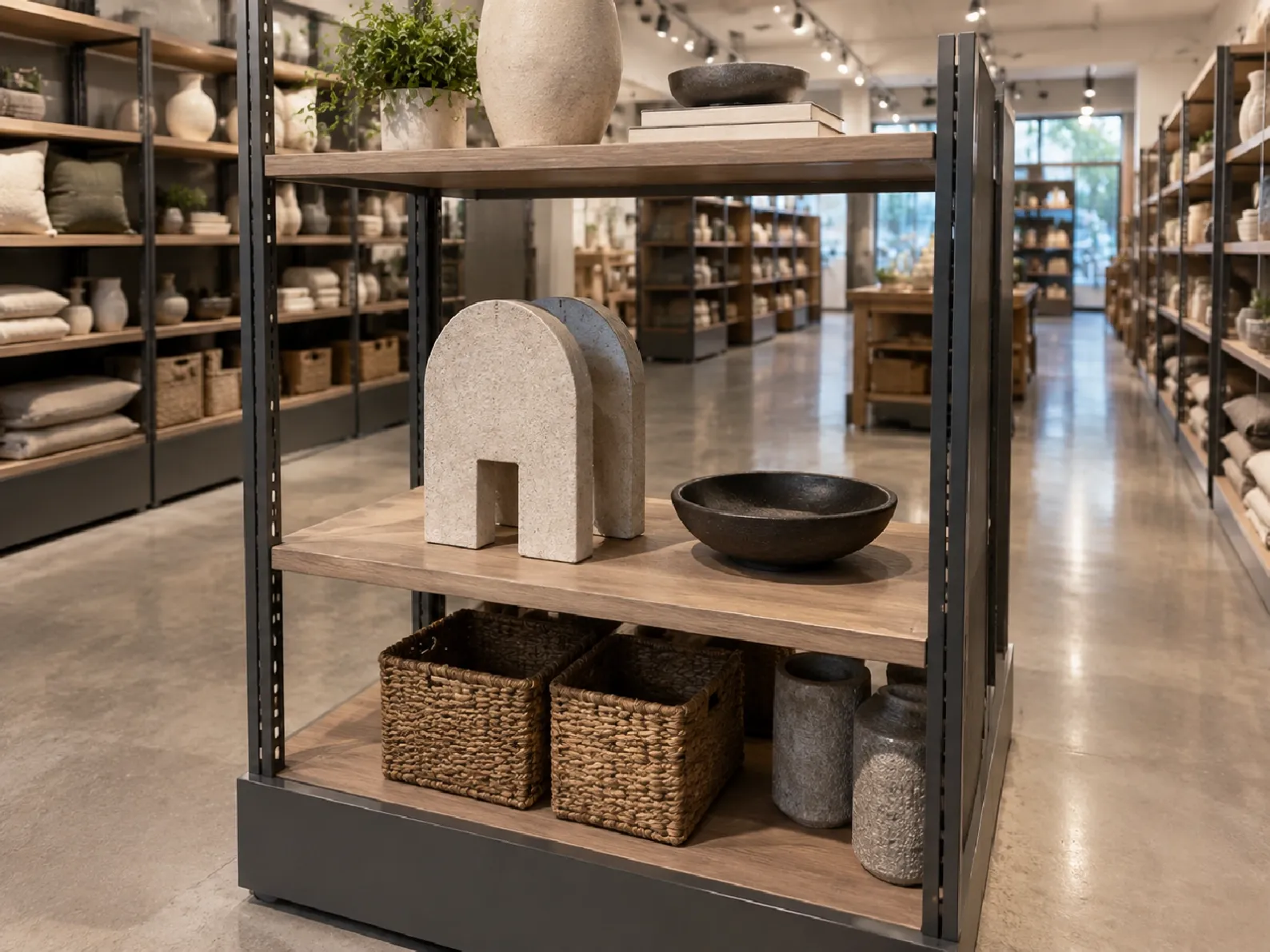
A decorative object can be attractive in its catalogue front view and still be the wrong choice for a two-sided retail shelf. From the opposite aisle, customers may see a flatter reverse, an open cavity or an attachment that the front image never showed.
For a retail brand, importer or distributor, the question is not whether every side must be decorated in the same way. It is whether the object is being sold for a display where shoppers will actually see those sides. That distinction matters before a product becomes a photographed, described and potentially continuing wholesale SKU.
An object designed to face one direction can be entirely appropriate. Problems arise when a front-facing item is presented as an all-round sculpture without establishing what the reverse looks like.
Open Retail Shelves Change the Customer's View
A wall-backed niche naturally limits what a shopper can see. A freestanding shelf between two aisles does not. An island table may expose the top, side and rear of a small decorative item as customers walk around it.
Intended placement | Customer-facing surfaces | Practical product decision |
|---|---|---|
Shelf against a wall | Front and accessible sides | A directional piece may fit if its front orientation is clear. |
Open-backed, two-sided shelving | Front, reverse and side profiles | The reverse appearance becomes a normal part of the display. |
Freestanding table or low display island | Top, side profiles and often reverse | The object should make visual sense from the approach directions used by shoppers. |
These are display circumstances, not universal finish requirements. An open-backed fixture does not automatically make every object unsuitable if it has a defined front. But a retailer should know which side is intended to face the shopper rather than discovering that only after merchandise is placed.
A Finished Reverse Is Not Necessarily a Second Front
Some sculptures are designed to read continuously from several angles. Others have a clearly defined front and an intentionally quieter reverse. A plain back, deliberate recess or open framework can be part of a complete design. The correct question is whether the reverse is consistent with the particular object being offered.
Consider a shallow decorative figure whose front carries most of the design. Against a wall, it may communicate exactly the intended form. In the centre of a store, its flat back could become the first thing customers see from another aisle. The product has not changed; the viewing situation has.
The same applies in the other direction. A lattice-style sculpture may have no single solid front. Its open structure can be central to how it is viewed, but the visible rear still needs to be understood for that model. A catalogue hero image is not proof that every view or treatment has been assessed.
Choose the Display Format Before Creating the Retail Listing
For continuing retail ranges, product imagery often outlives the first purchase. A listing may be reused by individual stores, online stockists and distributors with different display furniture. The risk is that an item described as freestanding and viewable from all around turns out to be intended primarily for front-facing use.
A buyer does not need a long technical report to address this. The important distinction is commercial: is it a directional shelf ornament, a freestanding decorative sculpture, or a shallow top-view accessory? Those descriptions are not interchangeable.
A front view communicates the main design. For an item intended for open shelving, a side or three-quarter view shows its depth and exposed contour, while a reverse view communicates what a customer on the other side would see. This is different from using extreme close-ups to discuss resin texture, marble edges or metal joining details; those issues belong to separate product or material evaluations.
An unsupported statement such as “perfectly finished from every angle” can create expectations that the public product images do not substantiate. Describe the actual selected item and intended placement instead.
Three Product Shapes, Three Different Expectations
A shallow decorative tray is normally judged largely from above. Its underside is not necessarily a second decorative face. If a retailer wants to use it on a glass shelf or sell it as an object customers pick up, the actual contact surface and handling requirements should be confirmed separately.
An upright figurative object may be directional: its main design is intended to face forward. The side depth and the reverse can still matter to the merchandising plan, particularly when multiple stores use different shelving layouts.
A freestanding open-form sculpture may be approached from several directions. Its side and reverse profiles become part of the selected appearance, not merely hidden construction areas. That does not guarantee equal visual interest from every view or eliminate the need for product-specific confirmation.
These examples are meant to distinguish display uses, not to rank materials or recommend one design style for every store.
Two MUENHUIDECOR References Illustrate the Difference
The gold iron and crystal orb tabletop sculpture is listed with a twisted open-lattice form, a clear crystal element and two size options. It is a relevant reference when discussing a sculptural item whose outline may be visible from more than one direction.
By contrast, the brass hand-shaped trinket tray has a shallow, upward-facing decorative surface. That makes the top view important for its intended use, rather than suggesting the underside should carry an identical pattern.
Both are genuine catalogue references, not comparisons of inspected front and back finishes. Their listings do not establish every reverse-side treatment, safety characteristic or alternative configuration. Buyers should confirm the selected product and its intended presentation before relying on a particular all-round appearance.
Why This Matters to Repeat Wholesale Customers
A retail brand may buy an initial quantity for a small number of stores and later expand distribution if the item sells. Different outlets may place the same product on wall shelving, display islands or open fixtures.
The useful first decision is to identify the object's intended selling orientation. A front-facing product can remain a successful SKU without becoming an all-round sculpture. An open-display item should be described according to its actual visible appearance. This helps keep product imagery and commercial descriptions aligned when the assortment reaches more stores.
It is not a promise of continuous supply, identical handmade details or fixed future pricing. Those are separate matters. For production-batch questions, see our guide to repeat purchasing mixed-material décor.
What to Include in a Shelf-Decor Wholesale Enquiry
If your buying decision depends on viewing from more than one direction, describe that at the outset. An item image on its own does not tell a supplier whether the product will be sold on a wall shelf or a two-sided central display.
For a product-specific discussion, provide the selected item or reference image, preferred dimensions, estimated quantity per design, destination country and target sales channel. Say which surfaces will face customers and whether this is a first retail test or a potential ongoing assortment. Include a target buying range or required arrival date if you already have one.
The objective is a discussion about a real product and quotation scope, not a free store-layout service. Available reverse treatments, sizes, packaging, MOQ, samples, timing and later supply have to be confirmed for the selected design.
Explore Wholesale Decorative Objects With MUENHUIDECOR
MUENHUIDECOR supplies decorative lighting, artwork and selected FF&E décor for wholesale buyers and hospitality interiors worldwide. Decorative objects can be sourced as a standalone category for retail collections, importers, distributors and commercial spaces; a lighting purchase is not required.
Explore our decorative objects collection for actual product references. If your selected item requires a change in dimensions, finish or presentation, our custom and semi-custom supply overview explains the general enquiry route; specific options are subject to review.
Send your wholesale decorative-object enquiry with the product reference, quantities, destination and expected display orientation so we can discuss the selected item and quotation scope.