Oct 29, 2026Wholesale & Customization
Wholesale Marble & Metal Decorative Objects: Will the Finished Piece Match?
Buying marble-and-metal decorative objects for resale? See how joins, stone edges and metal finishes affect whether the finished piece matches your chosen design.
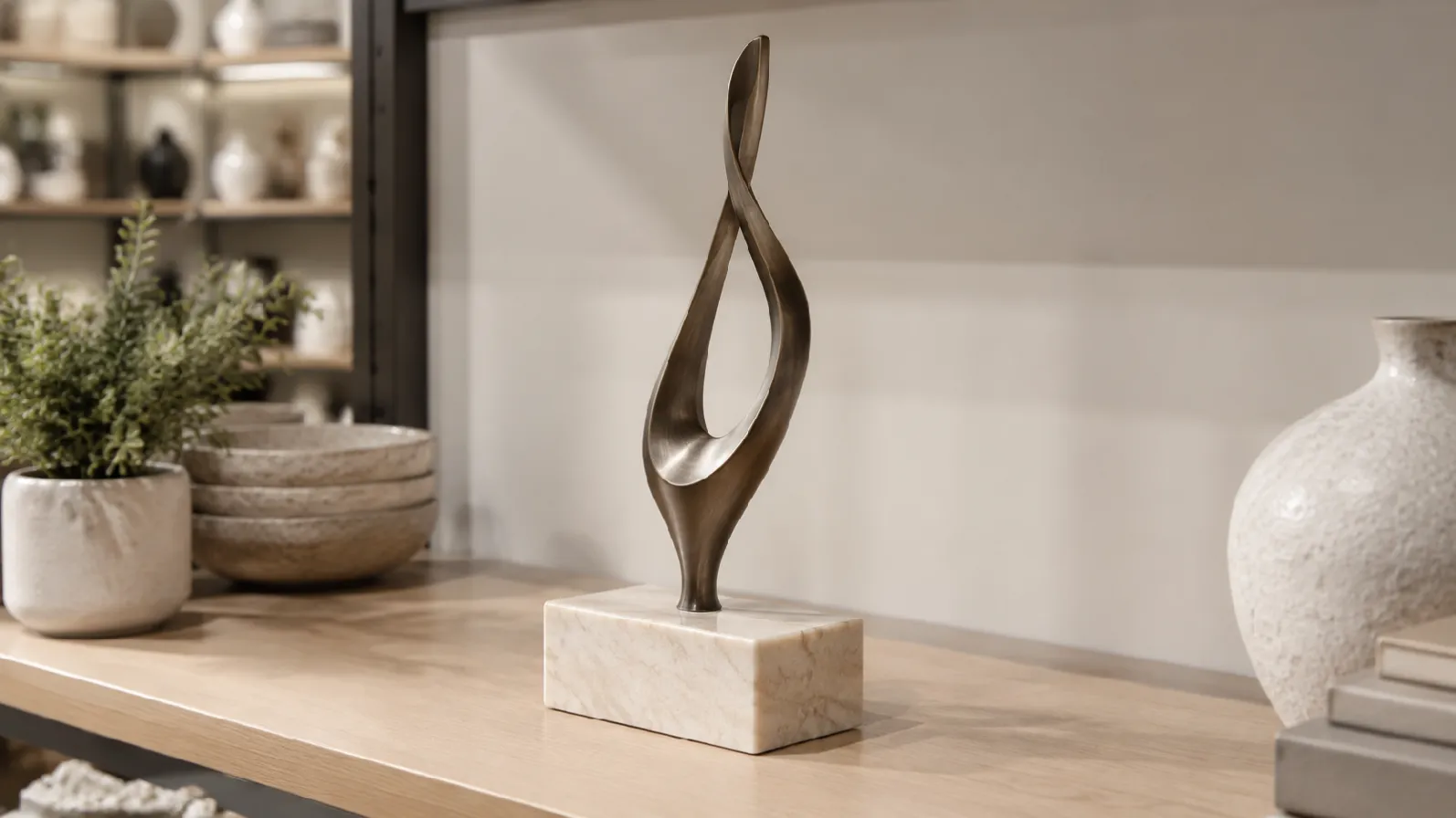
A marble-and-metal decorative object may look right in a catalogue but lose its character in the finished piece. A thicker connector, a different marble edge or a shifted metal accent can change the silhouette that first persuaded a retailer to select it.
For importers, distributors and retail brands, that difference matters beyond the first order. Product photography, catalogue descriptions and customer expectations are built around a recognizable design. Before comparing prices, ask whether the assembled object still looks like the product you chose.
Natural marble veining can vary. The position of the metal element, the shape of the base and the specified finish are separate design decisions. They should not be dismissed as ordinary material variation.
The Complete Silhouette Matters More Than a Material List
Imagine a metal sculpture rising from a compact marble base. In the selected design, a narrow visible connection may make the metal form look light and continuous. If the finished connector becomes visually bulky, the object can feel heavier or less balanced even though its two main materials have not changed.
The opposite can also be true: a visible metal collar may be an intentional feature. A concealed join is not automatically better. The important question is whether the transition matches the selected composition when the object is viewed as a whole, both straight on and from an ordinary display angle.
This is especially relevant to a retail SKU. Customers see an assembled product, not separate descriptions of “marble” and “metal.” The silhouette is what they may recognize from the retailer's online listing or shelf display.
Where Marble and Metal Meet: Intentional Detail or Unwanted Change?
Different objects place visual emphasis in different places. On a freestanding sculpture, the meeting point between the upward metal form and its base may sit near the center of attention. On a small stone ornament with a leaf or stem, the metal accent may be tiny but still essential to recognizing the motif.
An intentionally off-center element may belong to an asymmetrical design. An element that has shifted away from the selected reference is another matter. Likewise, a deliberate visible connector is different from an unexpected gap or an exposed join that interrupts the planned shape.
A close-up photograph can reveal the appearance of this area but cannot establish how the parts are fixed or whether a metal element is load-bearing. Those facts require confirmation for the selected product if they affect use or handling.
Stone Edges and Metal Finishes Change the Final Product
A marble base with a defined bevel can look different from one with rounded corners or a nearly square edge. The change may be particularly noticeable on a simple geometric sculpture because the base occupies a clear part of the visual design. A broader bevel can make the upper face appear smaller, even when the overall footprint is similar.
Metal finish changes the impression too. A satin gold-tone element, a polished reflective surface and an aged-looking finish do not present the same visual character. The most elaborate finish is not necessarily the right one; the selected finish should support the product's intended market and design.
At quotation stage, the buyer should know which visible edge treatment and metal finish are included. A cheaper alternative with a different appearance may be a valid separate option, but it should not quietly replace the selected version.
Normal Marble Variation Is Not the Same as Design Mismatch
Natural marble may vary in veining and tone between pieces. Whether a specific variation is acceptable depends on the agreed product appearance. It does not make every difference in the finished assembly acceptable.
What changes | How a wholesale buyer should interpret it |
|---|---|
Veins or tonal movement within the agreed stone appearance | Potentially normal natural-material variation; compare against the selected reference |
Metal leaf, stem or sculpture element in a visibly different position | Potential design mismatch, not a consequence of marble veining |
Base changes from a specified bevel to a rounded edge | Different visible design detail that should be separately agreed |
Specified satin metal finish becomes highly reflective | Different surface appearance requiring clarification |
Unexpected chip, loose component or visible gap | Product condition or assembly question to resolve, not a “handmade” selling point |
These are commercial distinctions, not universal technical tolerances. A photograph may not reliably distinguish a natural vein from a crack, or a lighting reflection from a different metal finish. For a significant order, evaluate the relevant evidence for the actual selected product instead of assuming that one image tells the whole story.
What Retailers, Distributors and Hospitality Buyers Actually See
In a retail store, customers may examine a decorative object at arm's length. An awkward join or inconsistent edge can be obvious on a shelf, especially when the brand's website shows a cleaner reference. The retailer needs a product description that accurately matches what is being sold.
For distributors supplying multiple retailers, the design identity must also make sense in product photography and sales materials. An unexpectedly different version cannot always be sold under the same visual description simply because its materials and dimensions are similar.
In a hotel reception or lounge, a decorative sculpture may first be judged from farther away, where shape and proportion dominate. Its connection and edge treatment still need to look appropriate at closer viewing distances. The setting changes which feature is most noticeable; it does not turn an unwanted design change into an acceptable one.
Compare the Same Finished Item Within the Buying Range
Two quotations are not equivalent if one covers the selected, assembled sculpture and the other refers to a different metal finish, revised stone edge or separate components. Confirm the actual design, size, material description, visible finish and delivered product format being priced.
For retail or distribution, packaging and any included display component can also affect the complete purchasing cost. Keep product price separate from freight, import charges and local handling where applicable. None of these details proves that one offer is automatically better, but without a comparable finished scope a unit-price comparison can be misleading.
If the target buying range cannot accommodate the selected appearance, discuss an alternative as a clearly identified alternative. A changed finish should not be presented as an identical version of the original design.
Two MUENHUIDECOR Product References Illustrate Different Priorities
MUENHUIDECOR's metal sculpture with a marble base shows a type of object where the vertical metal shape and stone base need to work as a single visual form. Its public listing describes a metal-alloy frame, marble base, gold finish and two size options. It does not specify every joint detail or establish how the components are attached.
The white marble apple with brass leaf and stem presents a different visual priority: the stone body is the main form, while the smaller metal accent completes the recognizable apple shape. The public listing identifies two sizes. It does not demonstrate that every alternative attachment or metal treatment is available.
These are catalogue references, not documented before-and-after production comparisons. Actual specifications and available adaptations need to be confirmed against the requested item.
A Recognizable Product Is a Better Starting Point for Repeat Wholesale Sales
If an object performs well in a retail range, the customer may later ask for the same recognizable design. A meaningful first selection therefore identifies the silhouette, visible joint, base edge and finish that make the product distinct—not merely “stone with gold metal.” This does not promise identical marble veining or future availability.
Our separate article on repeat purchasing of mixed-material décor addresses later production-batch discussions. This guide is about choosing the right finished appearance in the first place.
Discuss a Specific Wholesale Marble-and-Metal Object
MUENHUIDECOR supplies decorative lighting, artwork and selected FF&E décor for global wholesale and hospitality buyers. Decorative objects can be discussed independently for retail assortments, import programs, distribution and commercial interiors.
Explore the decorative objects range for product references. If you have a selected design, send its link or image, preferred size, approximate quantity per design, destination country and intended sales channel. Identify the appearance that must remain recognizable—such as the metal position, base edge or finish—and indicate whether the piece is intended for a continuing retail line. A target buying range and requested arrival date are useful when available.
Available materials, finishes, adaptations, packaging, sample arrangements, minimum order terms and lead times depend on the specific product and order. For potential changes, see our custom and semi-custom supply overview.
Send your wholesale decorative-object enquiry to discuss the selected finished product and the scope of a quotation.