
The Art of Precision: Choosing Spotlights for Gallery & Retail Lighting
Introduction: Light as a Curator
In a gallery or high-end retail store, light is not merely functional—it is a curator and a salesperson. Its job is to reveal truth, evoke emotion, and command attention without drawing attention to itself. Achieving this requires moving beyond standard lighting to the realm of precision spotlights, engineered specifically for the demanding task of display.
Chapter 1: The Non-Negotiables: CRI and Color Consistency
When the integrity of color is paramount, fixture specifications become critical.
CRI (Color Rendering Index) 90+ is Essential: A CRI of 95 or higher is the professional standard for art lighting. It ensures reds appear vibrant, skin tones look natural, and the subtle nuances in a painting or fabric are fully revealed. 80 CRI, common in household LEDs, is insufficient and will make colors look dull and inaccurate.
Consistency is King: All spotlights in a display must have identical color temperature (e.g., all 3000K) and CRI to ensure uniform appearance. Batch-to-batch variation is unacceptable.
Chapter 2: Optical Precision: Beam Control is Everything
The ability to shape and direct light defines a precision spotlight.
Beam Angles: Use narrow beams (10°-15°) to tightly frame a single small artwork or product. Use medium beams (24°-36°) for larger pieces or groupings.
Clean Cut-off & Field: A high-quality optical system produces a beam with a sharp, defined edge (“cut-off”) and even brightness across its spread (“field”), without distracting hotspots or color fringing.
Adjustability: Gimbal or track-mounted fixtures that allow for precise aiming (tilt and swivel) are mandatory for flexible display layouts.
Chapter 3: The Glare Battle: Protecting the Viewing Experience
Harsh glare from a spotlight can ruin the viewing experience as quickly as poor color can.
The Enemy: Direct View of the LED Source. Even at a sharp angle, the bright chip can be visible and uncomfortable.
The Solutions: Professional spotlights incorporate **deep regressed optics, internal baffles, and especially honeycomb louvers. These micro-cell grids act like thousands of tiny tunnels, allowing light to pass through while blocking direct line-of-sight to the LED source, dramatically reducing glare.
Chapter 4: Conservation Considerations
Light is energy, and energy can damage sensitive materials.
UV/IR Radiation: Ensure spotlights emit no ultraviolet (UV) and minimal infrared (IR) radiation to prevent fading and heat damage to artworks, textiles, and pigments.
Dimming: Full-range, flicker-free dimming allows curators to lower light levels for delicate works while maintaining optical performance.
Conclusion: The Invisible Hand
The perfect gallery or retail spotlight acts as an invisible hand, guiding the viewer’s gaze, revealing the object’s full splendor, and creating an emotional connection—all while remaining completely unobtrusive. Investing in fixtures that meet these precise optical, colorimetric, and anti-glare standards is not an expense; it is a fundamental commitment to preserving and presenting value
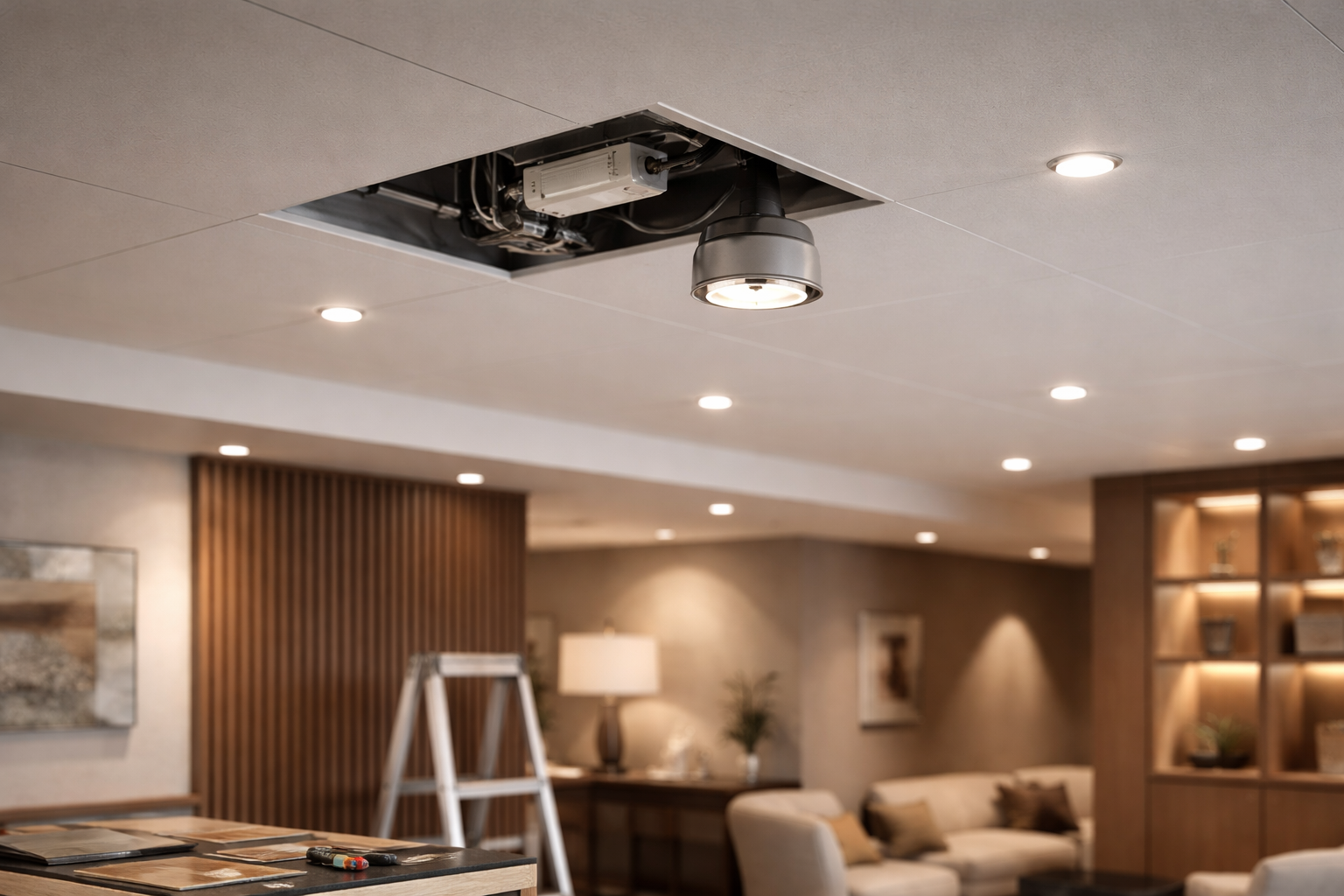 FM Lighting Replacements Without Guessing: Check Driver and Dimming Compatibility Before the Fixture Looks “Ready to Replace”
 Hotel & Serviced Apartment Refresh: Check Circuits & Dimming Before Choosing Fixtures
 Why multi-stakeholder projects rush timelines but delay decisions
 Layered Lighting 101: The Fastest Upgrade That Changes a Home