
Aug 29, 2026Project & Procurement
Why Mock-Up Approval Does Not Mean Lighting Is Ready for Project Rollout
A lighting fixture can work in a mock-up and still be unready for wider rollout. See why repeatability matters before project procurement is frozen.
Why Mock-Up Approval Does Not Mean Lighting Is Ready for Project Rollout
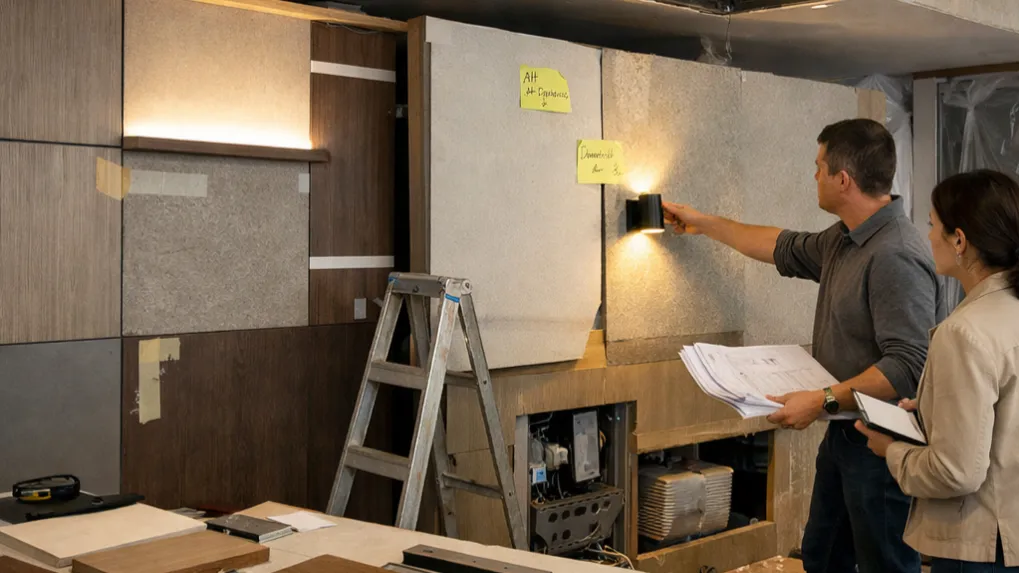
A lighting fixture can look resolved in a mock-up and still be unready for wider project rollout.
This distinction matters in hospitality and commercial projects where one approved lighting direction may later need to repeat across dozens or hundreds of guest rooms, corridors, villas, offices or other areas.
The sample may look right.
The model room may support the design intent.
The fixture may even appear ready for procurement.
But visual approval and repeatable project execution are not always the same thing.
A Mock-Up Confirms One Condition
Mock-ups are valuable because they allow project teams to see how a lighting decision performs in a real or near-real environment.
They can confirm important aspects of the design direction, including proportion, finish, visual relationship with the interior and the overall appearance of the installed fixture.
What they do not automatically prove is that the same result will remain straightforward when the condition changes.
A fixture that works well in one model room may later need to accommodate different ceiling depths, room layouts, fixing conditions, surrounding finishes or installation sequences.
Once the project moves from one approved example to repeated procurement, those differences begin to matter.
What Works Once May Not Be Ready to Repeat
This becomes especially important in hotels and other projects with repeated room types.
A decorative pendant, recessed fitting, wall light or customized feature may perform well in the first approved location.
The commercial question is whether that same decision remains workable when it is repeated across many locations.
Small differences that were insignificant in the mock-up can become more important when multiplied across a project.
The issue is no longer only whether the fixture looks correct.
It is whether the selection can remain consistent enough for procurement, installation and later phases without repeatedly reopening the same decision.
Visual Approval Can Create Premature Confidence
Once a sample or mock-up has been accepted, teams naturally want the project to move forward.
That momentum is necessary.
The risk appears when visual approval is treated as confirmation of every condition that will matter later.
Lighting rarely exists independently from the rest of the interior.
Depending on the fixture, the final result may interact with ceiling construction, fixing locations, adjacent finishes, joinery, installation access, control requirements or other packages.
Those relationships may not all be visible when the design direction is first approved.
A selection can therefore be visually settled while some of its project interfaces remain unsettled.
Repetition Changes the Commercial Risk
The importance of this distinction grows with project scale.
A small adjustment affecting one fixture may be manageable.
The same adjustment affecting 80 guest rooms, several room types or multiple project phases becomes a different commercial issue.
It can influence procurement pace, installation clarity, consistency, replacement planning and the amount of coordination required to keep the original design intent intact.
This is why repeatability deserves attention before a lighting decision becomes difficult to reopen.
The concern is not that every fixture requires excessive review.
The concern is whether a project-specific lighting decision is being treated as fully resolved before its wider conditions are sufficiently stable.
Custom Lighting Is More Sensitive to Early Freeze Decisions
Customized lighting often carries more project-specific assumptions than standard products.
Dimensions, suspension arrangements, finishes, mounting details, quantities or proportions may all have been developed for a particular interior condition.
That makes early approval useful, but it also makes later changes potentially more disruptive.
A custom decorative fixture can be completely appropriate for the design and still create pressure later if the conditions surrounding its wider use have changed.
For project teams, the important distinction is therefore not simply:
“Has the fixture been approved?”
It is:
“Is the approved fixture ready to be repeated under the conditions the project will actually have?”
Those are different questions.
Site Problems Often Begin Before Site
When a lighting issue appears during installation, it is easy to describe it as a site problem.
Sometimes the site is only where the earlier assumption becomes visible.
A ceiling condition proves less consistent than expected.
A detail that worked in one room becomes difficult in another.
A fixture that looked straightforward in isolation becomes dependent on another package.
A customization that suited the original reference becomes harder to repeat across additional locations.
By that stage, the project is no longer discussing design preference.
It is dealing with the downstream effect of a decision that was frozen before all of its relevant relationships had become clear.
Approval Should Support Rollout, Not Reopen It
The purpose of early approval is to help the next project phase move with greater certainty.
When a lighting decision is genuinely ready for rollout, procurement and installation should not need to reinterpret the same basic selection every time the condition repeats.
That does not mean every site variable can be eliminated in advance.
It means the difference between an approved visual direction and a procurement-ready lighting decision should be recognized.
For large hospitality and commercial projects, that distinction becomes more important as quantities increase, room types multiply and the same design intent must be carried across more locations.
A useful principle is:
What works once is not automatically ready to repeat.
The larger the rollout, the more commercially important that distinction becomes.
Reviewing Lighting for a Multi-Room or Multi-Phase Project?
If your project has approved lighting references, mock-up information or custom fixture concepts that now need to move into wider procurement, send us the available drawings or reference images together with the project location, approximate quantities, room or area types and required delivery stage.
We can review whether the requirement is suitable for quotation and project supply discussion.