Oct 7, 2026Wholesale & Customization
Metal vs Stone vs Resin vs Ceramic: Choosing Decorative Objects for Wholesale
Compare metal, stone, resin and ceramic decorative objects by commercial fit, visual character and buyer priorities before placing a wholesale order.
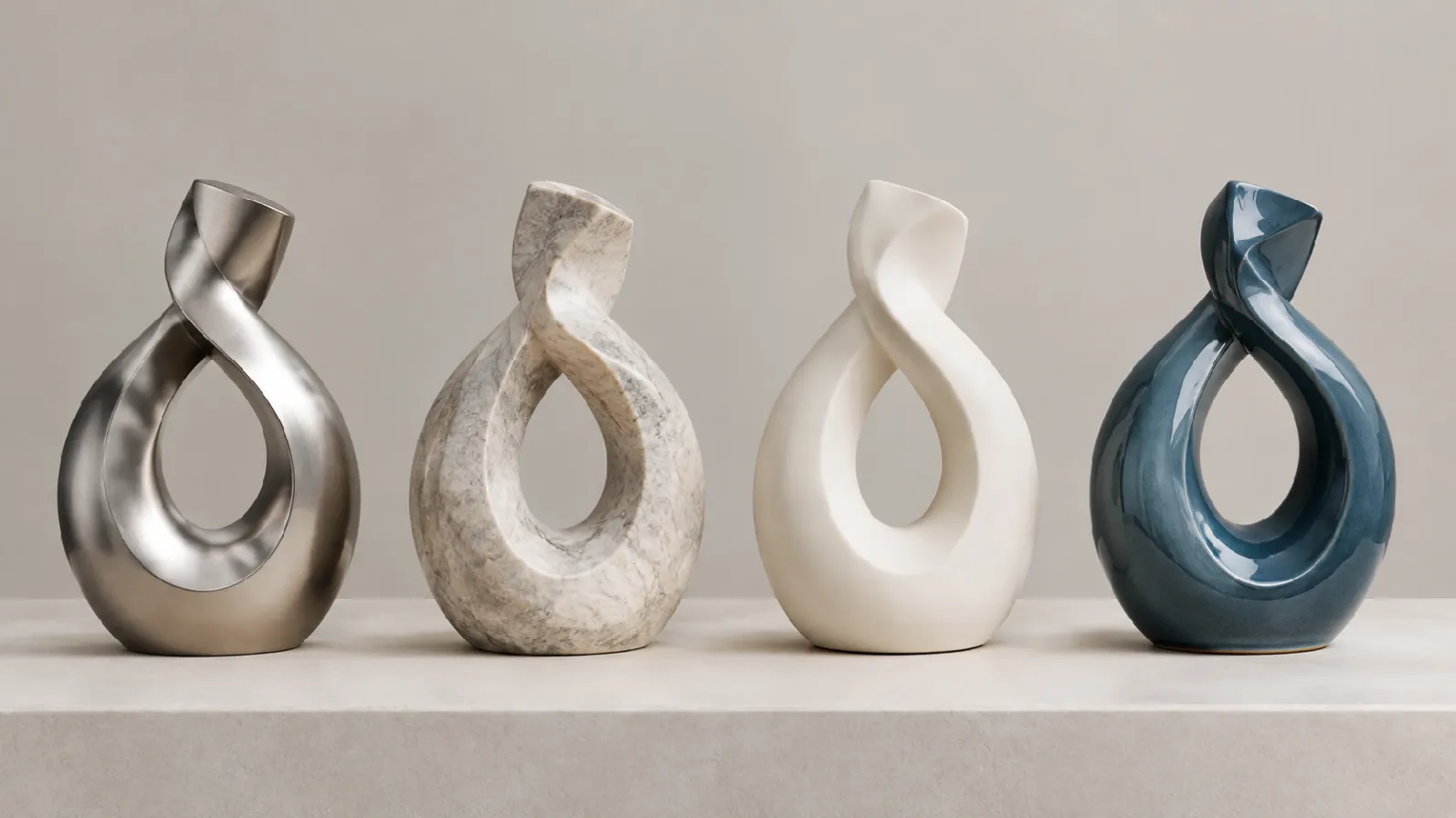
A buyer may have one decorative-object reference and still face four very different product directions.
Developing the same visual concept in metal, stone, resin or ceramic can change more than the material name. It can change how the object feels, how much natural variation is visible, which forms are practical, how the surface is perceived and where the product fits commercially.
For retailers, importers, interior brands and hospitality buyers, the useful question is therefore not:
Which material is best?
It is:
Which material best supports this particular decorative object and the market or application we are buying it for?
That distinction matters before a commercial order is placed.
Start With the Product Concept, Not a Material Ranking
Metal, stone, resin and ceramic should not be ranked from “best” to “worst.”
Each material creates a different relationship between form, surface and perceived product character.
Before comparing materials, buyers should clarify four things:
Is the material itself part of the product's selling point?
A natural stone object may derive much of its character from the stone itself. A sculptural resin object may derive more of its value from shape and surface treatment.
How important is visual uniformity?
Some materials naturally introduce more visible variation than others. Whether that is an advantage or a problem depends on the product concept and buyer expectation.
Is the form simple or highly sculptural?
A material that works well for a clean geometric form may not be the first option to discuss for a detailed sculptural concept.
Where will the product sit commercially?
A retailer developing an accessible tabletop object may evaluate materials differently from an interior brand developing a signature decorative piece or a hotel selecting objects for a defined interior concept.
Material choice should follow these decisions rather than replace them.
Metal: When the Surface and Silhouette Need to Read Clearly
Metal is worth discussing when the product depends strongly on a metallic surface, crisp profile or structured visual character.
The commercial appeal may come from elements such as a brushed, polished, dark, antique or metallic finish rather than from natural material variation.
Metal can therefore make sense for decorative objects where the silhouette and surface treatment are central to the design.
However, buyers should not evaluate a metal object only by a color label such as “gold,” “bronze” or “black.”
Two products described with the same color can look very different once the surface texture and finish direction change.
Metal may be a stronger direction when:
The product relies on a recognizable metallic appearance.
The form benefits from a clear, structured silhouette.
The finish plays an important role in the visual identity.
The object needs to coordinate visually with other metallic elements in a commercial interior or product range.
Metal may require another look when:
The concept depends heavily on natural variation.
A softer ceramic or stone-like visual character is central to the design.
The reference only specifies a metallic color but does not define the intended surface character.
For a serious inquiry, the useful discussion is not simply “Can you make this in metal?”
It is whether the form and intended finish work together for the actual product.
Stone: When the Material Itself Is Part of the Visual Value
Stone creates a different product proposition because its natural character can remain visible in the finished object.
Veining, tonal variation and surface differences can contribute to the identity of a stone decorative piece.
That can be commercially attractive when buyers want the material itself to be part of the product story.
It also means buyers should decide whether natural variation is acceptable before treating stone as the preferred option.
Stone may be a stronger direction when:
Natural material character is important to the concept.
Variation between individual pieces supports rather than weakens the intended appearance.
The object is meant to create a visually substantial or material-led impression.
The design does not depend on every piece appearing visually identical.
Stone may require another look when:
The commercial brief expects extremely uniform appearance from piece to piece.
The product form is better defined by another material than by the natural character of stone.
The buyer is choosing stone only because it is assumed to be more “premium.”
Stone should not automatically be treated as the premium option.
A well-developed ceramic, metal or resin object may fit a particular brand or market more effectively.
The decision depends on the product, not a generic material hierarchy.
Resin: When the Form Is More Important Than the Material Story
Resin can be worth considering when a decorative object is driven primarily by sculptural form, molded detail or a controlled decorative surface.
In these cases, the buyer may care more about the shape and finished appearance than about showing the natural identity of the underlying material.
This makes resin particularly relevant to some sculptural decorative concepts.
Resin may be a stronger direction when:
The shape is an important part of the product identity.
The concept includes sculptural or detailed forms.
The surface is intended to create a defined decorative effect.
The buyer is evaluating the finished object primarily by its form and appearance.
Resin may require another look when:
The buyer wants the inherent character of a natural material to remain visible.
The product story depends specifically on genuine stone, ceramic or metal.
Resin is being selected only because it is assumed to be the cheapest material.
That last point matters.
Resin should not automatically be treated as the low-price option.
Product dimensions, shape, finish, development requirements and quantity all affect the actual commercial result.
Choosing resin simply to chase the lowest unit price can create the wrong product direction before quotation even begins.
Ceramic: When Color, Glaze and Surface Character Lead the Design
Ceramic is worth considering when the decorative character comes from the relationship between form, color and surface.
A ceramic object may use a clean matte appearance, a glossy surface, a textured treatment or another ceramic finish direction.
This can make ceramic particularly relevant when the surface needs to feel integral to the object rather than applied as a separate visual effect.
Ceramic may be a stronger direction when:
The surface and color are central to the concept.
The product benefits from the visual character associated with a ceramic object.
The form suits the intended ceramic direction.
The buyer wants the material and surface to work together as part of the design.
Ceramic may require another look when:
The reference depends on a form better suited to another material direction.
The buyer expects every surface effect to appear completely identical without first defining acceptable appearance.
Ceramic is being chosen simply because the buyer assumes it will automatically look more expensive.
As with the other materials, the finished product should be evaluated against the actual commercial brief.
A Practical Commercial Comparison
The following comparison is not a ranking. It is a way to decide which material discussion should come first.
Buyer Priority | Material Direction to Discuss | Main Reason |
|---|---|---|
Metallic finish and structured silhouette | Metal | Surface and form are central to the product identity |
Natural material character | Stone | The material itself contributes strongly to the appearance |
Sculptural or form-led object | Resin | Shape and controlled decorative surface may be the main priorities |
Color, glaze and tactile surface | Ceramic | Surface character can be integral to the object |
Highly uniform appearance | Do not choose by material name alone | The actual design and acceptable variation need to be defined first |
Lowest possible price | Do not choose material yet | A price-only material decision can produce the wrong commercial product |
The final choice still depends on the specific reference, dimensions, finish expectation, quantity and intended application.
The Same Reference Image Does Not Always Mean the Same Product
This is where many material discussions become commercially unclear.
A buyer may send one image and ask:
“Can you quote this in metal, stone, resin and ceramic?”
Technically, several material directions may sometimes be worth discussing.
Commercially, however, they are not automatically four equivalent versions of the same product.
Changing material may also change:
- the visual character;
- the way the form is interpreted;
- the surface expectation;
- the perceived product positioning;
- and what the buyer is actually offering to the market.
For that reason, comparing four material quotations only by unit price can produce a misleading decision.
The better approach is to identify which one or two material directions genuinely fit the product concept first.
Then quotation becomes a comparison between realistic product options rather than unrelated interpretations of the same photograph.
How the Decision Changes by Buyer Type
Different commercial buyers may look at the same object differently.
Retailers and Importers
The material needs to support how the SKU will be presented and sold.
The buyer may consider whether the object belongs in an accessible decorative range, a stronger statement category or a more material-led assortment.
The material decision should support that role.
Interior Brands
For an interior brand, material may become part of the brand's visual language.
A sculptural form in resin can communicate differently from the same concept interpreted in natural stone or metal.
The decision therefore needs to fit the product identity the brand wants to build.
Hospitality and Interior Design Buyers
For hospitality use, the application and interior concept usually matter more than choosing a material in isolation.
A stone object selected for one area may not serve the same visual purpose as a ceramic or metal interpretation elsewhere.
The question should remain tied to the actual space and design requirement.
When It Makes Sense to Request an Alternative Material
Requesting an alternative material can be useful when the product concept is already clear but the buyer is still deciding how the object should be positioned.
For example, a buyer may know:
the approximate form,
the dimensions,
the intended market or application,
and the required visual direction,
but still want to compare whether the concept works better in resin or ceramic.
That is a commercially useful material discussion.
It is different from asking suppliers to quote every possible material simply to identify the lowest price.
A focused comparison gives both buyer and supplier a clearer product brief.
Choose the Material Around the Order You Are Actually Preparing
Metal, stone, resin and ceramic can all be appropriate for decorative objects.
None should be treated as automatically:
more premium,
more economical,
more durable,
or more suitable for wholesale.
The material needs to support the actual product concept.
For a buyer preparing an order, the practical sequence is:
define the object → define its commercial role → identify the most realistic material direction → discuss the actual requirement.
That produces a more useful supplier conversation than selecting a material from a generic ranking.
Discuss a Decorative Object Material With MUENHUIDECOR
If you are preparing a decorative-object order and are deciding between metal, stone, resin, ceramic or another suitable material, send MUENHUIDECOR:
your product reference, approximate dimensions, expected quantity, target market or application, preferred material direction if known, and delivery destination.
If the material is still open, indicate which options you are considering.
We can review the requirement against the actual product concept rather than recommend one material as universally better than another.
Preparing a decorative-object order?
Send your product reference, approximate dimensions, expected quantity, target market or application, material options you are considering, and delivery destination.
MUENHUIDECOR can review the material direction against the actual product requirement rather than recommend one material in isolation.