Wholesale & Customization
Compare fabric-shade table lamps and glass-shade fixtures for hotel and wholesale ranges. See what matters before requesting a product-specific quote.
Compare fabric-shade table lamps and glass-shade fixtures for hotel and wholesale ranges. See what matters before requesting a product-specific quote.
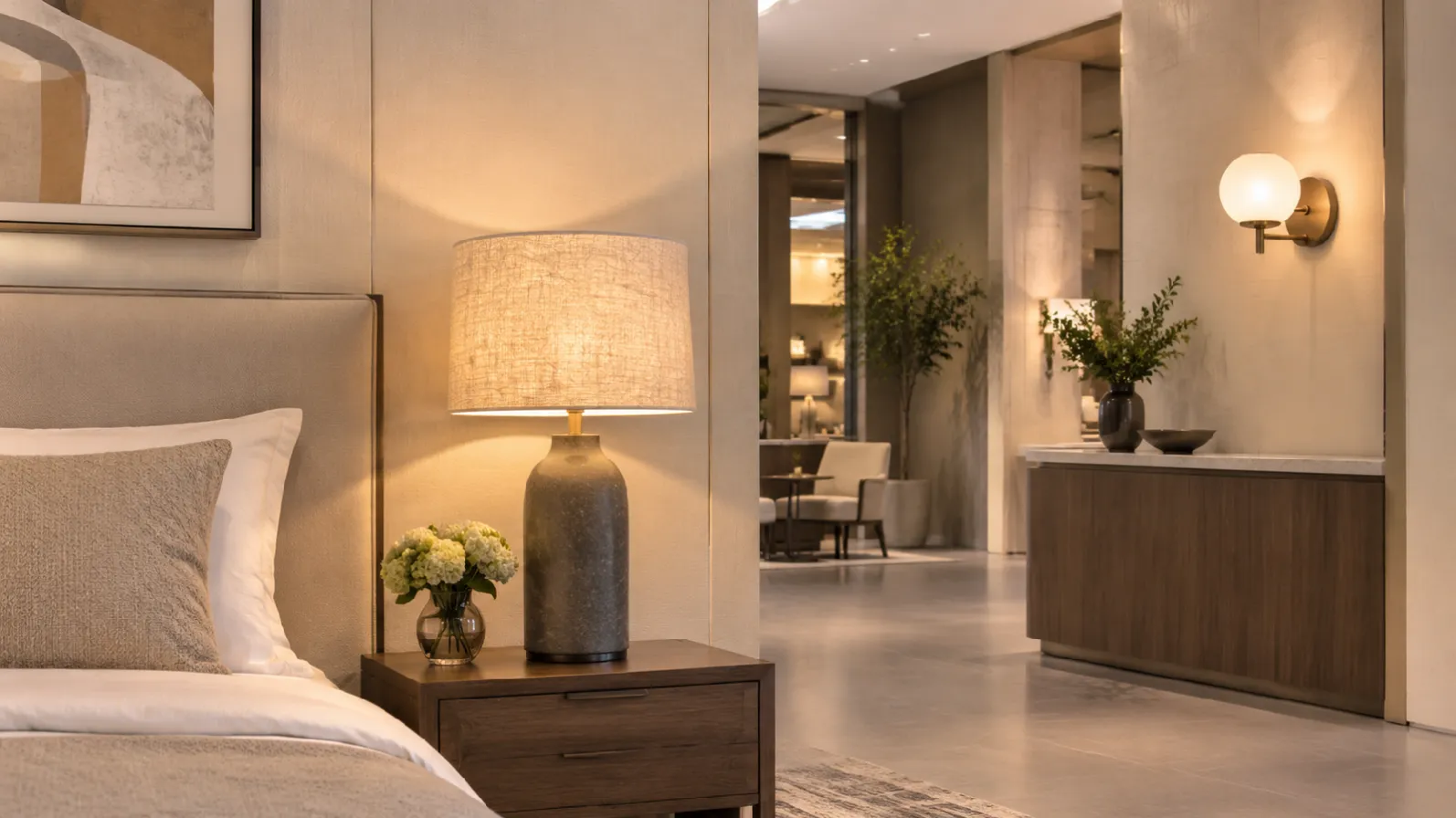
A lighting distributor is preparing a small selection of decorative fixtures for hotel and interior-design customers. One direction is a table lamp with a fabric shade; another is a glass-globe wall light. Both use a shade to shape the finished product, but they are not two versions of the same lamp—and their shades should not be treated as interchangeable parts.
The commercial question is not simply whether fabric or glass looks better. Which complete lighting design fits the buyer's customers, the intended space and the first wholesale order? A hotel owner may care about one interior scheme. A retail brand or importer also needs to know what finished product it can accurately present to trade accounts.
This comparison is for buyers choosing complete hospitality and wholesale lighting. It is not a catalogue of independently available replacement shades, nor a claim that MUENHUIDECOR can adapt an existing third-party lamp to either material.
First Clarify What You Are Buying
A fabric-shade table lamp, a glass-globe wall light and a multi-glass pendant are different fixture families. Their mounting, proportions, light sources and intended locations vary. The shade is one element of the product, not a universal component that can be exchanged between them.
For an importer creating a lighting range, the useful starting point is a complete model the business could offer for resale. For a hotel operator, it is a complete fixture suited to an identified guestroom, corridor or public area. If the request concerns a loose shade for a lamp already installed, that is a separate parts-and-compatibility enquiry, not the purchasing decision addressed here.
Where Fabric-Shade Lighting Fits the Commercial Brief
Fabric shades may suit buyers looking for a textile-led decorative appearance in guestrooms, bedside settings and lounges. Their color, visible texture and proportion contribute to the identity of the complete lamp. A fabric shade does not, by itself, guarantee a particular level of diffusion, stain resistance or service life; these depend on its actual construction and application.
MUENHUIDECOR's modern sculptural table lamp with a fabric shade is a concrete wholesale product reference. Its public listing identifies a stainless-steel body, a fabric shade and options for discussing selected finish, shade color, fabric and dimensional changes. The warm bronze or brass-toned appearance is a finish description, not a claim that the body is made of solid brass.
The hotel bedside wall sconce with fabric shade and reading light serves a different brief. It combines a decorative fabric-shade element with a separate reading function in a wall-mounted format. A retailer should not describe that fixture as interchangeable with the freestanding table lamp merely because both use fabric.
For a resale collection, the buyer's question is which complete model and appearance match the intended customer. For a guestroom installation, the question also includes the fixture's actual lighting function and mounting conditions.
Where Glass-Shade Lighting Fits the Commercial Brief
Glass shades can give a finished fixture a distinctive visible form. A spherical globe, a clear glass element and an irregular frosted shade should not be treated as equivalent visual products. The resulting lit appearance depends on the particular glass, shape, light source and complete fixture design.
MUENHUIDECOR's decorative glass-globe wall light is listed as a complete metal-and-glass wall fixture for hospitality and wholesale enquiries. Its public product information describes glass and finish options for review. It does not demonstrate that the globe can be sold alone or fitted to an unrelated lamp.
Another product direction is the pebble-glass cluster pendant for hotel staircases. The glass pieces are part of a suspended multi-light assembly, so a buyer evaluates the overall configuration and the space it is intended to occupy—not just the individual glass shade.
These examples help trade buyers identify which complete product family they want to discuss. They are not evidence that glass is universally easier to maintain or better suited to every commercial area.
Fabric vs Glass: Compare Commercial Use, Not a Material Winner
Buying question | Fabric-shade complete fixture | Glass-shade complete fixture |
|---|---|---|
What will the customer recognize? | The chosen textile character together with the lamp's form and finish | The glass form and surface character together with the fixture's overall architecture |
Which spaces could be relevant? | Selected guestrooms, bedside locations, lounges or textile-led retail collections | Selected reception areas, corridors, restaurants or feature-lighting collections, depending on the model |
What needs care review? | Actual fabric, backing, dust or stain exposure, and model-specific instructions | Actual surface, coating, access, impact exposure, and model-specific instructions |
What is the buyer ordering? | A specified complete table lamp or wall light, unless parts supply is separately confirmed | A specified complete wall light or pendant, unless parts supply is separately confirmed |
What supports a later trade discussion? | An identified approved complete model and version | An identified approved complete model and version |
A material preference does not establish electrical suitability, maintenance performance, price, durability or replacement availability. Those claims require evidence for the particular item and destination market.
Cleaning, Handling and Light Effect Are Model-Specific
An operating hotel may want surfaces that staff can care for without affecting the appearance of guest-facing areas. A retailer may instead ask what product information it can confidently give end customers. Both need manufacturer-supported care guidance for the exact fixture rather than a blanket statement that fabric is difficult or glass is easy.
Fabric surfaces may call for attention to dust, marks or the effect of cleaning on the actual finish. Glass introduces different handling questions, including possible impact, breakage and access to the shade. A textured or coated glass surface cannot automatically be treated like plain smooth glass.
Lighting performance requires equal caution. A product image does not prove the level of diffusion or glare. If a buyer is comparing candidate fixtures for a hotel setting, the lighting effect, electrical configuration, controls, installation and relevant market requirements must be reviewed against the specified product. Neither shade material is a substitute for that confirmation.
A Retail Range and a One-Off Hotel Installation Are Different Orders
A wholesale lighting buyer is not necessarily purchasing for a single room. An importer may be assessing a fabric-shade table lamp for multiple retail accounts; a distributor may offer a glass wall light to several hospitality designers. This makes the intended sales channel important when choosing an initial model.
A successful first range listing might lead to another order, but that outcome depends on demand, the agreed product and future supply conditions. MUENHUIDECOR's published model descriptions allow buyers to discuss wholesale and selected customization requirements; they do not guarantee perpetual availability, unchanged components or automatic replenishment.
The detailed process of managing a custom table lamp over multiple orders is covered separately in why a customized table lamp may be harder to repeat later. Here, the commercial decision comes first: which identifiable finished fixture belongs in the proposed range?
Replacement Shades Require a Different Enquiry
Sometimes a hotel needs only a damaged shade replaced on an existing lamp. That is not equivalent to selecting a new fabric- or glass-shade complete fixture. A different material cannot be assumed to fit the original mounting, weight, clearance or lighting arrangement.
If you need shade-only supply, specify the existing lamp model and whether the requested part is an original replacement. MUENHUIDECOR would first need to confirm whether that part and quantity fall within its supply scope; compatibility or standalone availability must not be assumed. For broader operating-hotel replacement concerns, see the separate guide to why low-cost lighting replacement can become expensive.
Request a Wholesale Review for a Specific Complete Fixture
MUENHUIDECOR supports international trade enquiries for decorative and selected architectural lighting, including complete table lamps, wall lights and pendants. Buyers can start from the lighting product catalogue or a linked product reference in this guide.
For a focused discussion, identify your company or brand, the complete fixture or product link, the first expected quantity per model or version, destination country, intended retail or distributor channel or hospitality space, and the appearance or electrical requirements that are essential. If you anticipate future purchases, explain whether this is a new wholesale range, an established trade programme or continuing hospitality supply; future availability will still require confirmation.
This information helps frame an actual product-and-quantity enquiry rather than an open-ended request for free shade redesign or compatibility advice. Any available changes, samples, documentation, minimums and delivery terms must be reviewed for the specific fixture.
Contact MUENHUIDECOR about a complete-fixture wholesale enquiry with your selected reference, market and quantity.